
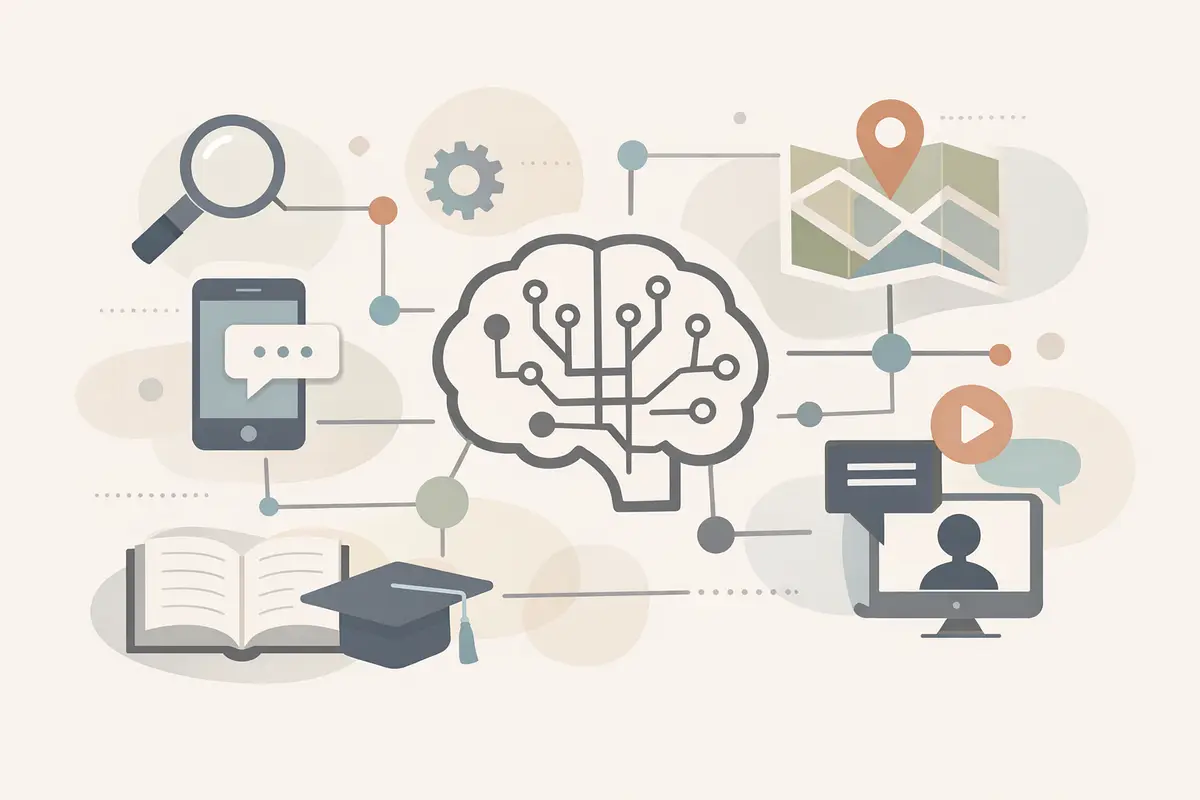
Artificial intelligence is often described as a futuristic technology, but in reality, it is already part of everyday life. Most people interact with AI-powered systems daily without always realizing it. From smartphones to online services, artificial intelligence helps make technology more efficient, personalized, and responsive.
Understanding these everyday examples becomes easier once you know the basics of what artificial intelligence is and how AI systems operate. AI is not limited to advanced robotics or research laboratories. It is integrated into common tools designed to assist users by analyzing data and recognizing patterns.
This article explores practical examples of artificial intelligence in daily life and explains how these systems support users in simple, functional ways.
Advertisement
Artificial Intelligence Is Already Around Us
AI does not operate independently like a human mind. Instead, it functions through mathematical models trained on data. These systems are designed to complete specific tasks efficiently.
You may not see AI directly, but it works behind the scenes in many digital services. Recognizing where AI is used helps remove confusion and unrealistic expectations about what the technology can do.
Let’s look at some of the most common areas where AI appears in daily life.
AI in Smartphones
Smartphones are one of the clearest examples of artificial intelligence in everyday use.
Advertisement
Face and Fingerprint Recognition
When you unlock your phone using facial recognition or a fingerprint scanner, AI is analyzing stored patterns.
These systems:
- Compare your face or fingerprint with saved data
- Identify unique features
- Determine whether there is a match
The technology improves over time by refining pattern recognition accuracy. However, it does not “understand” your identity. It simply compares data patterns.
Voice Assistants
Voice assistants use artificial intelligence to interpret spoken language.
When you ask a voice assistant a question:
- The system converts speech into text.
- It analyzes the text using language models.
- It generates a response based on learned patterns.
These assistants rely on speech recognition and natural language processing. They do not think independently. They respond based on probabilities learned during training.
Camera Enhancements
Modern smartphone cameras use AI to improve image quality.
AI systems can:
- Detect faces
- Recognize scenes (such as landscapes or night shots)
- Adjust lighting and contrast
- Reduce noise
The camera automatically optimizes settings based on visual patterns. This improves user experience without requiring manual adjustments.
Predictive Text and Autocorrect
When typing messages, your phone predicts words or corrects spelling mistakes. These features use AI to analyze language patterns and past typing behavior.
The system predicts likely next words based on:
- Context
- Common word combinations
- Personal usage history
This speeds up communication but does not reflect true understanding of your message.
AI in Internet and Online Services
Artificial intelligence plays a major role in online platforms and digital services.
Search Engines
Search engines use AI to analyze search queries and deliver relevant results.
They evaluate:
- Keywords
- User intent
- Page content
- User behavior patterns
AI helps rank results based on relevance rather than simple keyword matching. It improves accuracy by learning from past interactions.
Content Recommendations
Streaming platforms and social media use AI to recommend content.
These systems analyze:
- Viewing history
- Search behavior
- User preferences
- Engagement patterns
Based on this data, AI suggests movies, videos, articles, or posts that match user interests.
These recommendations are statistical predictions, not personal understanding.
Email Spam Filtering
AI systems help identify spam emails by detecting patterns commonly associated with unwanted messages.
They analyze:
- Sender behavior
- Message structure
- Suspicious links
- Language patterns
This automated filtering reduces inbox clutter and improves security.
Language Translation
Online translation tools rely on AI to convert text between languages.
These systems:
- Analyze sentence structure
- Recognize context patterns
- Predict accurate translations
Although translation accuracy has improved significantly, AI may still misinterpret nuance or cultural context.
AI in Education
Artificial intelligence is increasingly used in educational environments.
AI tools can:
- Summarize long texts
- Provide simplified explanations
- Assist with language learning
- Help organize study plans
Some educational platforms adapt content difficulty based on student progress. This personalized learning approach uses pattern recognition to adjust recommendations.
However, AI in education works best as a support system. It cannot replace human teachers, mentorship, or critical thinking development.
AI in Navigation and Transportation
Navigation apps are another everyday example of artificial intelligence.
When you use a maps application:
- AI analyzes traffic data
- It studies historical patterns
- It predicts congestion
- It suggests alternative routes
These systems update recommendations in real time based on changing conditions.
Again, AI is identifying patterns and predicting outcomes, not making conscious decisions.
AI in Smart Home Devices
Smart home devices use AI to improve convenience and automation.
Examples include:
- Smart thermostats adjusting temperature
- Smart lighting responding to user behavior
- Security systems detecting unusual activity
These devices analyze usage patterns and adjust settings automatically.
They operate based on learned preferences rather than independent judgment.
AI in Online Customer Support
Many websites use AI-powered chat systems to answer common questions.
These systems:
- Recognize user queries
- Match them to predefined solutions
- Provide automated responses
They improve response time and reduce workload for human support teams. However, complex issues often require human assistance.
What These Examples Show About Artificial Intelligence
Everyday examples reveal important truths about AI:
- AI supports human activity rather than replacing it
- AI relies on data and mathematical models
- AI performs specific, defined tasks efficiently
- AI does not think, feel, or act independently
Understanding these points prevents unrealistic expectations.
Artificial intelligence is practical, not magical.
The Invisible Nature of AI
One reason AI is often misunderstood is that it works quietly in the background. Users see results but not the processing behind them.
For example:
- You see recommended videos but not the data analysis behind them.
- You receive spam filtering without seeing pattern detection algorithms.
- You unlock your phone without seeing facial pattern comparisons.
AI systems are embedded in user-friendly interfaces, making their presence less obvious.
Why Recognizing Everyday AI Matters
Recognizing how AI is already integrated into daily life helps people:
- Understand its practical role
- Avoid exaggerated fears
- Use technology more responsibly
- Develop informed expectations
When AI is seen as a supportive tool rather than an independent intelligence, discussions about its future become more balanced.
Conclusion
Artificial intelligence is already embedded in many aspects of daily life, often in subtle and practical ways. From smartphones and search engines to navigation apps and smart home devices, AI enhances efficiency and personalization.
These systems analyze data, recognize patterns, and generate outputs based on learned models. They do not think independently or replace human judgment.
By recognizing real-world examples of AI, users can develop a realistic understanding of what the technology does and how it should be used. Artificial intelligence works best as a supportive technology that enhances human capabilities rather than replacing them.
For a clearer perspective on both strengths and limits, it is helpful to explore what AI can and cannot realistically do in practical situations.