
Artificial intelligence tools are now widely used in education, workplaces, and everyday digital services. Many people interact with AI tools regularly without fully understanding how they function behind the scenes. While these systems may seem complex, their core working principles are easier to understand than many assume.
Learning how AI tools work helps users develop realistic expectations, avoid common misunderstandings, and use these tools more responsibly. If you are new to this topic, it is helpful to first understand what artificial intelligence means at a basic level. Once the foundational idea is clear, the mechanics of AI tools become easier to follow.
This guide explains how AI tools operate in simple terms, without technical jargon or programming knowledge.
What Is an AI Tool?
An AI tool is a software application that uses artificial intelligence methods to perform specific tasks. These tasks may include:
- Generating text
- Analyzing data
- Recognizing images
- Interpreting language
- Recommending products or content
- Organizing or summarizing information
Unlike traditional software that follows fixed rules written by programmers, AI tools rely on learned patterns. They are trained on large amounts of data and use statistical models to produce outputs.
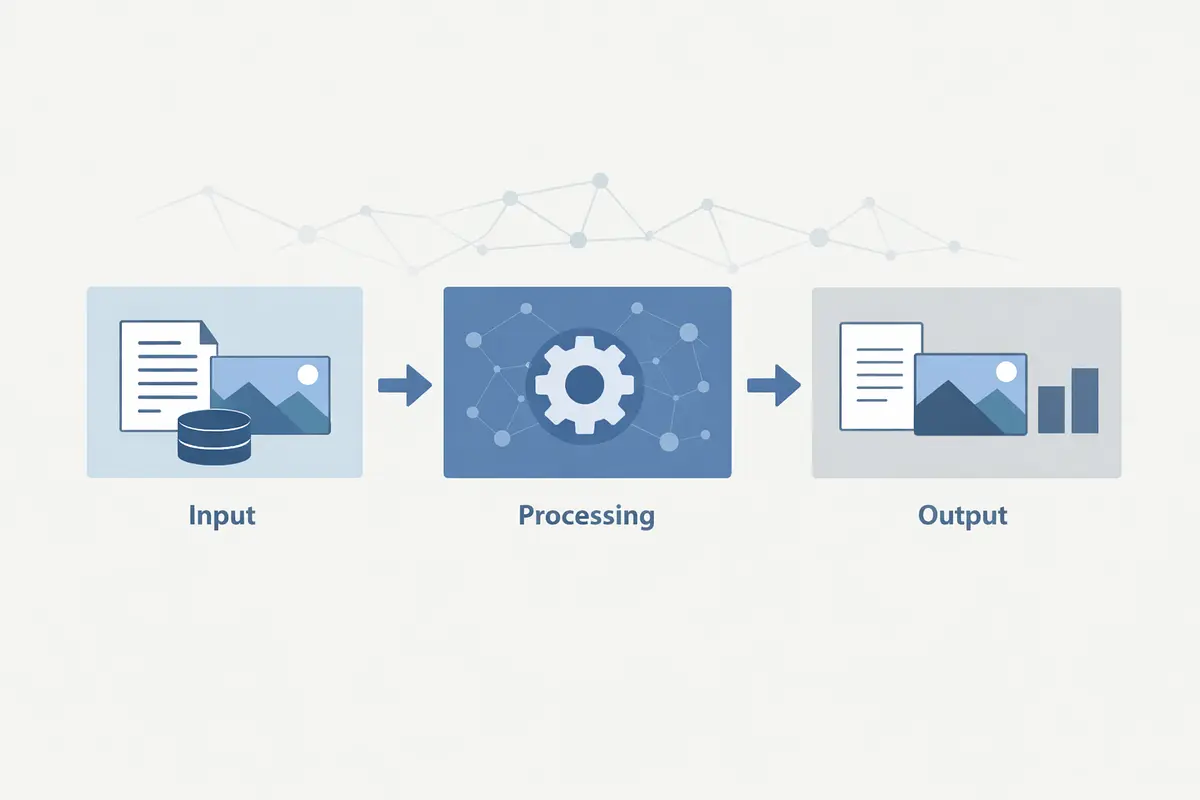
In simple terms, an AI tool processes input, analyzes it using patterns learned during training, and generates output based on probability rather than strict instructions.
The Foundation of AI Tools: Data
Data is the core ingredient of every AI system. Without data, AI tools cannot function.
During development, AI models are trained using large collections of relevant information. The type of data depends on the task the tool is designed to perform.
For example:
- Language-based AI tools are trained on text data such as books, articles, and online content.
- Image recognition systems are trained on labeled images.
- Recommendation systems analyze user behavior patterns.
- Speech recognition tools learn from audio recordings.
The quality, diversity, and structure of this training data strongly influence how accurate and reliable an AI tool will be.
If the data is incomplete or biased, the tool may produce inaccurate or unfair outputs.
How AI Models Are Trained
Training is the learning phase of an AI system. During this stage, the model analyzes large volumes of data and adjusts its internal parameters to improve performance.
Although the mathematics behind training can be complex, the core idea is simple:
- The system reviews examples.
- It attempts to produce outputs.
- It compares its output with the expected result.
- It adjusts internal calculations to reduce errors.
This process is repeated thousands or millions of times. Over time, the model improves its ability to predict or classify correctly.
For instance:
- A spam filter learns by reviewing examples of spam and non-spam emails.
- A language model learns by predicting the next word in sentences repeatedly.
- An image classifier improves by analyzing labeled images and correcting mistakes.
Once training is complete, the model can apply what it has learned to new, unseen inputs.
From User Input to AI Output
When you interact with an AI tool, a structured process occurs behind the scenes.
Step 1: Input
You provide information to the tool. This may be:
- A written question
- A voice command
- An uploaded image
- A dataset
- A search query
Step 2: Processing
The AI model analyzes your input using patterns learned during training. It compares your input to similar examples it has encountered before.
Step 3: Output Generation
Based on statistical probabilities, the system generates a response. This could be:
- A paragraph of text
- A recommendation
- A classification
- A prediction
- A summary
The response may appear intelligent, but it is generated through pattern recognition and probability calculations rather than true understanding.
Common Types of AI Tools
AI tools can be grouped into broad categories based on the tasks they perform.
Text-Based Tools
These tools generate, analyze, or summarize written content. They are commonly used for writing assistance, research support, and document organization.
Image and Media Tools
These systems recognize objects in images, enhance photos, or generate visual content using learned visual patterns.
Productivity Tools
AI-powered productivity tools help organize tasks, suggest schedules, or automate repetitive workflows.
Educational Tools
In learning environments, AI tools may assist with language practice, research summarization, or feedback on assignments.
Although these tools differ in function, they rely on similar underlying principles: training on data, identifying patterns, and generating outputs based on probability.
Why AI Tools Sometimes Make Mistakes
AI tools are powerful but not perfect. Their outputs depend on:
- The quality of training data
- The design of the model
- The clarity of user input
- The limitations built into the system
AI tools may produce:
- Inaccurate information
- Outdated content
- Biased outputs
- Overconfident responses
They do not verify facts independently. They generate responses based on learned patterns, not real-time understanding.
For this reason, AI-generated information should be reviewed carefully, especially in academic or professional contexts.
Why AI Tools Do Not “Understand” Information
One of the most common misunderstandings is the belief that AI tools understand information like humans do.
In reality, AI systems:
- Do not have awareness
- Do not have beliefs
- Do not form intentions
- Do not experience emotions
They identify statistical relationships between data points.
For example, when a language model generates text, it predicts the next word based on probability calculations learned from patterns in training data. It does not “know” what it is saying.
This distinction is important. The output may appear meaningful, but the process behind it is mathematical, not conscious.
The Role of Human Oversight
AI tools are designed and controlled by humans. Human developers:
- Choose training data
- Define system objectives
- Set boundaries and restrictions
- Monitor system performance
- Update and improve models
Users also play an important role. Responsible use requires reviewing outputs, verifying information, and applying human judgment.
AI tools function best as support systems rather than independent decision-makers.
Using AI Tools Responsibly
Responsible AI use involves understanding both benefits and limitations.
Practical guidelines include:
- Verifying important facts independently
- Avoiding over-reliance on automated outputs
- Being cautious with sensitive or personal data
- Recognizing potential bias in results
- Using AI as assistance, not authority
When used thoughtfully, AI tools can increase productivity and support learning. When used carelessly, they may lead to mistakes or misunderstandings.
The Growing Presence of AI Tools
AI tools are becoming more common across industries.
In education, they assist with:
- Language practice
- Research summaries
- Study organization
In business, they support:
- Customer communication
- Data analysis
- Forecasting
- Automation
In daily life, they power:
- Search engines
- Navigation systems
- Online recommendations
Understanding how these tools work helps users make informed decisions about when and how to rely on them.
Conclusion
AI tools work by analyzing data, identifying patterns, and generating outputs based on probability. They do not think, reason, or understand information in the human sense. Instead, they rely on training data and mathematical models.
Although these tools can be highly useful, they have clear limitations. Their outputs depend on data quality, system design, and user input.
By understanding how AI tools function, non-technical users can:
- Use AI systems more effectively
- Recognize their limitations
- Avoid unrealistic expectations
- Apply human judgment where necessary
AI tools are most powerful when combined with responsible human oversight.
To explore how artificial intelligence is applied in learning environments, you can read our guide on AI for students and common use cases in education and research.