
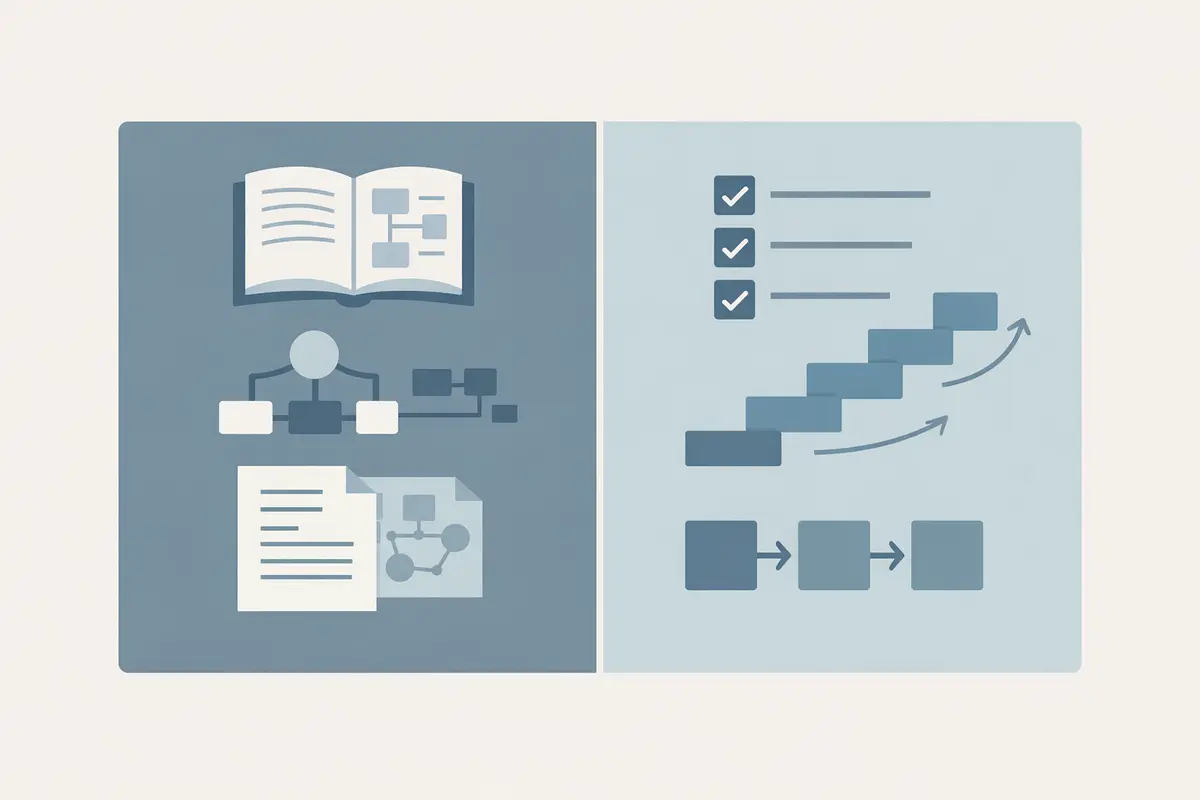
Artificial intelligence content is available in many formats. Two of the most common formats are AI tutorials and AI guides. Although these terms are often used interchangeably, they serve different learning purposes.
Understanding the difference between AI tutorials and AI guides helps readers choose the right type of content based on their goals. Whether someone is a beginner exploring artificial intelligence for the first time or a professional evaluating AI tools for practical use, selecting the correct format can make learning more efficient.
Both formats are valuable, but they support different stages of the learning journey.
What Are AI Guides?
AI guides are informational resources designed to explain concepts, technologies, or strategies in a structured and easy-to-understand way. Their primary goal is to build understanding rather than teach specific actions.
AI guides typically:
- Explain what a concept is
- Describe how it works at a high level
- Provide context and background
- Compare options or approaches
- Discuss benefits and limitations
- Highlight risks or considerations
Guides focus on clarity and explanation. They are especially useful for readers who want to understand artificial intelligence before applying it.
For example, a guide might explain:
- What artificial intelligence means
- How AI systems learn from data
- The difference between AI and traditional software
- How AI impacts businesses or education
Guides help readers develop informed judgment.
What Are AI Tutorials?
AI tutorials are instructional resources focused on practical application. They guide readers step by step through a process, tool, or workflow.
AI tutorials typically:
- Explain how to perform a specific task
- Follow a logical sequence
- Include step-by-step instructions
- Use examples or screenshots
- Focus on execution rather than theory
Tutorials are useful when readers already have basic understanding and want to apply what they have learned.
For instance, a tutorial might teach:
- How to set up an AI tool
- How to write effective prompts
- How to analyze AI-generated outputs
- How to configure automation settings
While guides focus on understanding, tutorials focus on doing.
Key Differences Between AI Tutorials and AI Guides
Although both formats are educational, their purpose and structure differ significantly.
AI guides:
- Focus on conceptual understanding
- Provide broader explanations
- Offer analysis and context
- Support decision-making
AI tutorials:
- Focus on action and execution
- Provide step-by-step instructions
- Help users complete tasks
- Build practical skills
In simple terms:
Guides answer the question:
“What should I understand?”
Tutorials answer the question:
“How do I do this?”
Both formats complement each other in the learning process.
When to Use an AI Guide
AI guides are best suited for readers who want broader understanding before taking action. They are particularly useful when evaluating options, comparing tools, or considering long-term implications.
For example, before choosing an AI platform for business use, a decision-maker may need to understand:
- What problem the AI tool is designed to solve
- Cost implications
- Data privacy concerns
- Required human oversight
- Scalability over time
- Potential risks or limitations
A guide provides context, perspective, and analysis. It does not necessarily teach how to use the tool step by step.
AI guides are ideal for:
- Business owners
- Managers and decision-makers
- Researchers
- Students evaluating career paths
- Readers exploring AI fundamentals
Guides support informed decision-making.
When to Use an AI Tutorial
AI tutorials are best suited for readers who want structured, practical instruction. They are particularly helpful for beginners who feel overwhelmed and need a clear starting point.
For example, someone learning to use an AI writing assistant may need instructions such as:
- How to create an account
- How to enter prompts
- How to adjust settings
- How to refine results
- How to export or format outputs
This step-by-step structure reduces confusion and builds confidence.
AI tutorials are especially useful for:
- Beginners
- Non-technical users
- Students starting a project
- Professionals trying a new AI tool
- Anyone needing immediate practical results
Tutorials simplify action by breaking tasks into manageable steps.
Why Both Formats Matter in AI Education
Artificial intelligence is a complex and rapidly evolving field. Relying on only one type of content can lead to gaps in understanding.
If someone reads only tutorials, they may learn how to use tools but lack strategic awareness. They might not understand risks, limitations, or long-term implications.
If someone reads only guides, they may understand concepts but struggle with practical implementation.
A balanced learning path includes both.
For example:
- A learner starts with a guide explaining how AI tools work.
- They read another guide comparing different AI platforms.
- Then they follow a tutorial to use one of those tools step by step.
This combination builds both informed judgment and practical ability.
How Learning Goals Determine the Right Format
Choosing between a guide and a tutorial depends on the reader’s objective.
If the goal is:
- Understanding AI fundamentals → Choose a guide.
- Comparing AI solutions → Choose a guide.
- Learning ethical implications → Choose a guide.
If the goal is:
- Completing a task → Choose a tutorial.
- Setting up a tool → Choose a tutorial.
- Improving workflow efficiency → Choose a tutorial.
Understanding your objective prevents wasted time and frustration.
AI Tutorials and Guides for Different Audiences
Different audiences benefit from different formats.
Students may start with guides to understand concepts before using tutorials to apply them in projects.
Business professionals may rely on guides for strategic decisions and tutorials for tool implementation.
Non-technical users often benefit from beginner-friendly tutorials, while researchers may prefer in-depth guides.
Educational platforms often organize content into both categories to support varied learning needs.
Avoiding Common Confusion
Many readers confuse AI tutorials and AI guides because both provide educational value. However, the difference becomes clear when focusing on intent.
A guide explains.
A tutorial demonstrates.
A guide builds knowledge.
A tutorial builds skill.
Recognizing this distinction allows readers to move through learning stages more efficiently.
Creating a Balanced Learning Path
For anyone learning artificial intelligence, a structured path might look like this:
- Start with beginner-friendly guides to understand core concepts.
- Explore comparison guides to evaluate tools and applications.
- Follow tutorials to apply knowledge in practical tasks.
- Return to guides to deepen understanding and refine strategy.
This cycle supports continuous growth.
Learning artificial intelligence is not only about using tools. It is also about understanding their purpose, strengths, and limitations.
Conclusion
AI tutorials and AI guides serve different but complementary roles. Guides focus on explanation, context, and understanding. Tutorials focus on application, structure, and practice.
Choosing the right format helps readers learn artificial intelligence more effectively and responsibly. If you are completely new to artificial intelligence, begin with a clear conceptual guide to build foundational understanding.
Once the basics are clear, structured tutorials can help you apply that knowledge in real-world situations.
A balanced learning approach that combines thoughtful analysis with practical instruction leads to stronger, more confident understanding of artificial intelligence.