
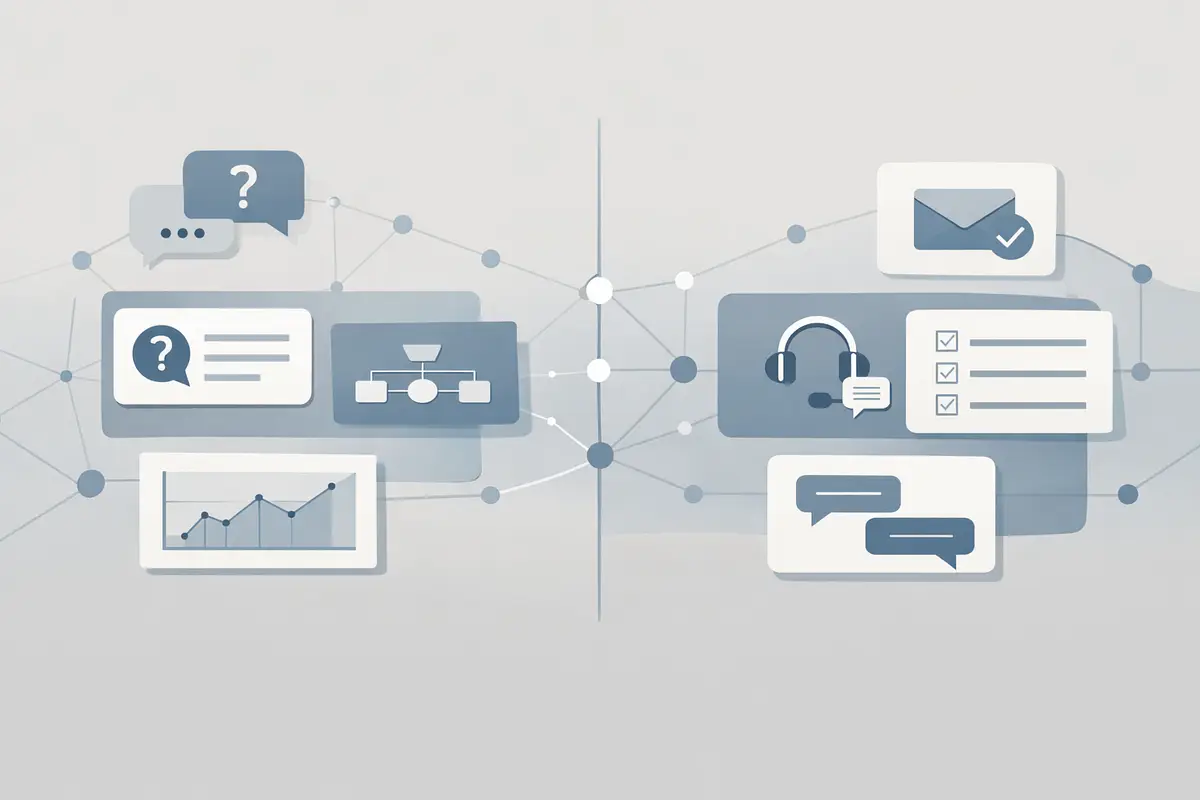
Artificial intelligence is increasingly being used to enhance customer service operations, offering faster response times and improved efficiency. From automated replies and chatbots to intelligent ticket routing systems, AI tools help streamline support processes and manage high volumes of customer inquiries. However, customer support remains a critical function in building trust and maintaining long-term relationships. While AI can assist with speed and organization, meaningful interactions and complex issue resolution still depend on human understanding and accountability.
However, while AI can assist customer support teams, it also comes with important limitations and risks. This article explains how artificial intelligence is used in customer support, where it adds value, where it falls short, and why responsible use is essential.
Customer support automation is one example of how businesses use artificial intelligence in daily operations.
Understanding AI in Customer Support
Artificial intelligence in customer support typically refers to systems that help manage, organize, or respond to customer inquiries. These systems do not understand customers in a human sense. Instead, they work by analyzing text patterns, keywords, and historical data to generate responses or actions.
In most businesses, AI is not meant to replace customer support staff. Instead, it is designed to assist human agents by handling repetitive tasks and organizing information more efficiently.
Common Uses of AI in Customer Support
Automated Responses to Frequently Asked Questions
One of the most common uses of AI in customer support is responding to frequently asked questions. AI systems can provide instant answers to basic inquiries such as order status, operating hours, or general policies.
This helps reduce wait times for customers and allows support staff to focus on more complex issues. However, automated responses work best only when questions are simple and predictable.
Ticket Routing and Categorization
AI systems are often used to sort and route customer inquiries to the appropriate department or support agent. By analyzing keywords and message structure, AI can classify requests more quickly than manual sorting.
This improves response time and reduces administrative workload. Still, incorrect categorization can occur, especially when customer messages are unclear or emotionally charged.
Support Analytics and Performance Insights
AI can assist customer support teams by analyzing large volumes of interaction data. These systems may highlight trends such as recurring complaints, response delays, or frequently requested features.
Such insights help businesses identify areas for improvement. However, analytics alone do not explain customer intent or satisfaction. Human interpretation is required to understand the underlying causes.
Assistance for Human Support Agents
Some AI tools are used internally to support customer service staff rather than interacting directly with customers. For example, AI can suggest draft responses, summarize past conversations, or surface relevant knowledge base articles.
These tools can improve efficiency, but final responses should always be reviewed by human agents to ensure accuracy and appropriate tone.
Benefits of Using AI in Customer Support
Faster Response Times
AI systems can operate continuously, providing instant replies to basic inquiries. This reduces waiting time and improves accessibility, especially outside normal business hours.
For customers with simple questions, faster responses can significantly improve the support experience.
Reduced Workload for Support Teams
By handling repetitive and predictable tasks, AI allows human agents to focus on issues that require judgment, empathy, and problem-solving.
This can help reduce burnout among support staff and improve overall service quality.
Consistency in Basic Information
AI systems deliver consistent responses based on predefined information. This reduces the risk of conflicting answers for standard questions and policies.
Consistency is especially useful in businesses with large volumes of similar inquiries.
Risks and Limitations of AI in Customer Support
Lack of Emotional Understanding
AI systems do not understand emotions, frustration, or urgency in the way humans do. They analyze text patterns but cannot truly empathize with customers.
When customers are upset or confused, automated responses may feel impersonal or unhelpful, potentially damaging trust.
Misinterpretation of Customer Messages
Customers often describe issues in unclear or informal language. AI systems may misinterpret intent, leading to incorrect responses or routing.
This can increase frustration rather than resolving the problem, especially when customers feel they are not being understood.
Over-Reliance on Automation
Excessive use of AI can make customer support feel distant and inflexible. Customers may struggle to reach a human agent when they need personalized assistance.
Over-automation risks turning customer support into a barrier rather than a service. Concerns about automation in customer service are often part of a broader discussion about AI and jobs.
Data Privacy and Responsibility
Customer support systems handle sensitive information. Businesses must ensure that AI tools follow privacy regulations and protect customer data.
Poor data handling can lead to trust issues and legal consequences.
The Importance of Human Involvement
AI works best in customer support when humans remain actively involved.
Human agents are essential for:
- Handling complex or emotional cases
- Making judgment-based decisions
- Resolving unique or unexpected situations
- Maintaining trust and empathy
AI should support human agents, not replace them.
Responsible Use of AI in Customer Support
Responsible AI use requires clear boundaries and thoughtful implementation.
Businesses should:
- Clearly define which tasks AI is allowed to handle
- Provide easy access to human support when needed
- Regularly review AI performance and outputs
- Train staff to work effectively alongside AI tools
Transparency helps customers understand when they are interacting with AI and when a human is involved.
When AI Is Not the Right Solution
AI may not be appropriate in all customer support situations.
Examples include:
- Handling complaints involving emotions or conflict
- Resolving billing disputes or legal matters
- Managing sensitive personal information
In these cases, direct human interaction is more effective and appropriate.
Setting Realistic Expectations
Businesses often adopt AI with expectations of immediate improvement. In reality, benefits are usually gradual and depend on careful configuration and monitoring.
AI should be introduced slowly, starting with low-risk use cases. Continuous evaluation helps prevent misuse and disappointment.
Balancing Efficiency and Customer Experience
Customer support is not just about speed. Quality, understanding, and trust matter equally.
AI can improve efficiency, but customer experience depends on:
- Clear communication
- Human empathy
- Accountability
Maintaining this balance is key to successful AI adoption.
Conclusion
Artificial intelligence can play a valuable supporting role in customer support by improving response times, reducing repetitive workload, and providing useful insights. However, it cannot replace human understanding, empathy, or judgment. Businesses should carefully decide whether AI is appropriate for customer support before implementing it widely.
Businesses that use AI responsibly recognize its limitations and keep humans at the center of customer interactions. When applied thoughtfully, AI enhances customer support without undermining the relationships that businesses depend on.