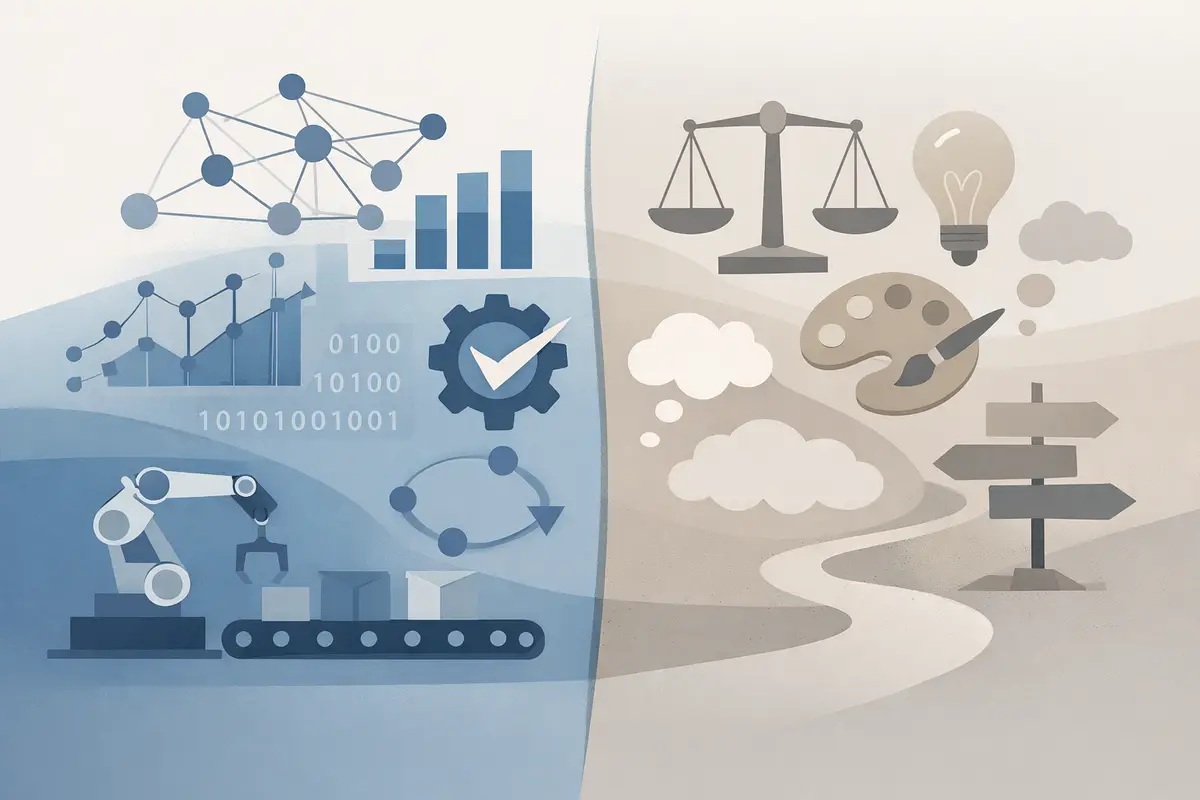
Understanding what AI can and cannot do is essential for students, professionals, and everyday users. Before evaluating its limits, it helps to understand what artificial intelligence actually is and how it works. AI systems are designed to perform defined tasks using data and mathematical models. They do not think, feel, or reason like humans.
Artificial intelligence is often described as a powerful technology that can change the world. Some people believe AI can solve almost any problem, while others fear it may replace humans entirely. In reality, artificial intelligence is neither magic nor a substitute for human intelligence. It is a tool with specific strengths and clear limitations.
This article explains where AI performs well, where it struggles, and why realistic expectations are important for responsible use.
Understanding the Purpose of Artificial Intelligence
Artificial intelligence is designed to help machines perform tasks that usually require certain aspects of human intelligence. These tasks include:
- Recognizing patterns
- Analyzing large amounts of data
- Identifying trends
- Understanding language at a surface level
- Making predictions based on past information
AI systems operate using algorithms trained on data. They do not possess awareness or independent thought. Instead, they detect patterns in information and generate outputs based on probabilities.
Recognizing this distinction is crucial. AI simulates aspects of intelligence through data processing, but it does not replicate human consciousness.
What Artificial Intelligence Can Do Well
AI performs best when tasks are clearly defined and supported by large volumes of structured data.
1. Pattern Recognition
One of AI’s strongest abilities is identifying patterns.
AI systems are widely used in:
- Image recognition
- Voice recognition
- Fraud detection
- Medical image analysis
For example, AI can analyze thousands of medical scans to detect patterns associated with certain diseases. Similarly, financial institutions use AI to identify unusual transaction patterns that may indicate fraud.
Humans can recognize patterns too, but AI can process vast amounts of data much faster.
2. Data Analysis and Prediction
AI excels at analyzing large datasets and generating predictions.
It is commonly used in:
- Weather forecasting
- Market analysis
- Recommendation systems
- Risk assessment
For instance, streaming platforms suggest content based on user behavior patterns. AI models analyze viewing history and compare it with patterns from millions of other users.
These predictions are based on probability, not understanding. Still, they can be highly effective when supported by quality data.
3. Automation of Repetitive Tasks
AI is especially useful for automating repetitive and time-consuming tasks.
Examples include:
- Sorting emails
- Processing applications
- Responding to common customer inquiries
- Managing inventory systems
Automation increases efficiency and reduces manual workload. This allows humans to focus on complex problem-solving and creative tasks.
However, automation works best when rules and processes are clearly defined.
4. Language Processing at a Statistical Level
AI can analyze and generate text using patterns learned from large language datasets.
This includes:
- Translating languages
- Summarizing information
- Generating responses
- Answering general questions
Although AI-generated text may appear thoughtful, it is based on statistical relationships between words. It does not understand meaning in a human sense.
What Artificial Intelligence Cannot Do
Despite impressive capabilities, AI has important limitations that are often misunderstood.
1. Think or Feel Like a Human
AI does not have:
- Consciousness
- Emotions
- Self-awareness
- Personal experiences
It processes input mathematically and produces output based on learned patterns. It does not “know” what it is saying or doing.
2. Make Moral or Ethical Judgments
AI cannot determine what is morally right or wrong. Ethical decisions require human values, cultural context, and responsibility.
AI systems may assist in decision-making by analyzing data, but humans must remain accountable for final decisions.
For example, in healthcare or legal systems, AI may provide recommendations. However, professionals must evaluate those recommendations carefully.
3. Function Without Quality Data
AI systems depend heavily on training data.
If data is:
- Incomplete
- Biased
- Inaccurate
- Outdated
The output will likely reflect those weaknesses.
AI cannot independently verify the truthfulness of its training data. It learns from what it is given.
4. Adapt Like Humans in Unfamiliar Situations
Humans can adapt to new situations using reasoning and creativity. AI systems operate within the boundaries of their training.
When faced with situations outside their training data, AI systems may:
- Produce incorrect results
- Generate irrelevant responses
- Fail entirely
Unexpected circumstances often require human intervention.
5. Replace Human Creativity and Empathy
While AI can generate text, music, or visual designs, true creativity involves intention, emotion, and lived experience.
Similarly, empathy and emotional understanding are uniquely human qualities. AI can simulate supportive language, but it does not experience emotion.
Human judgment, compassion, and ethical responsibility remain irreplaceable.
Common Misunderstandings About AI
Many misconceptions about AI come from media portrayals and exaggerated marketing claims.
Common myths include:
- AI is equivalent to human intelligence
- AI can make independent decisions
- AI always produces accurate results
- AI will fully replace human roles
In reality:
- AI tools depend on human design
- AI requires oversight
- AI outputs can contain errors
- AI is a support technology, not a replacement for humanity
Understanding these points prevents unrealistic expectations.
Why Realistic Expectations About AI Matter
Balanced understanding is essential for responsible AI use.
When people overestimate AI:
- They may trust incorrect outputs
- They may reduce critical thinking
- They may rely too heavily on automation
When people underestimate AI:
- They may ignore useful tools
- They may resist beneficial innovations
- They may miss opportunities for efficiency
The goal is not fear or blind trust. The goal is informed, thoughtful adoption.
The Importance of Human Oversight
AI systems function best when humans remain involved.
Responsible use includes:
- Reviewing AI-generated outputs
- Verifying important information
- Monitoring for bias or errors
- Maintaining accountability
In professional settings, AI should assist human decision-makers rather than replace them.
Human oversight ensures fairness, safety, and ethical responsibility.
AI as a Tool, Not a Replacement
Artificial intelligence is a powerful tool. Like any tool, its effectiveness depends on how it is used.
A calculator improves efficiency in mathematics, but it does not replace mathematical understanding. Similarly, AI can enhance productivity and analysis, but it does not replace human reasoning.
Viewing AI as a collaborative support system leads to healthier integration into education, business, and daily life.
Conclusion
Artificial intelligence has clear strengths and clear limitations. It can recognize patterns, analyze data, automate repetitive tasks, and assist with language processing. These capabilities make AI valuable across many industries.
However, AI cannot think, feel, or make ethical judgments. It depends on data, design, and human oversight. It does not possess consciousness or independent reasoning.
By setting realistic expectations, users can benefit from AI without misunderstanding its role. Understanding what AI can and cannot do is a foundational step toward responsible and effective use.
To explore practical real-life applications of artificial intelligence, you can review examples of AI in everyday life and see how these strengths and limitations appear in daily technology.